In this guide
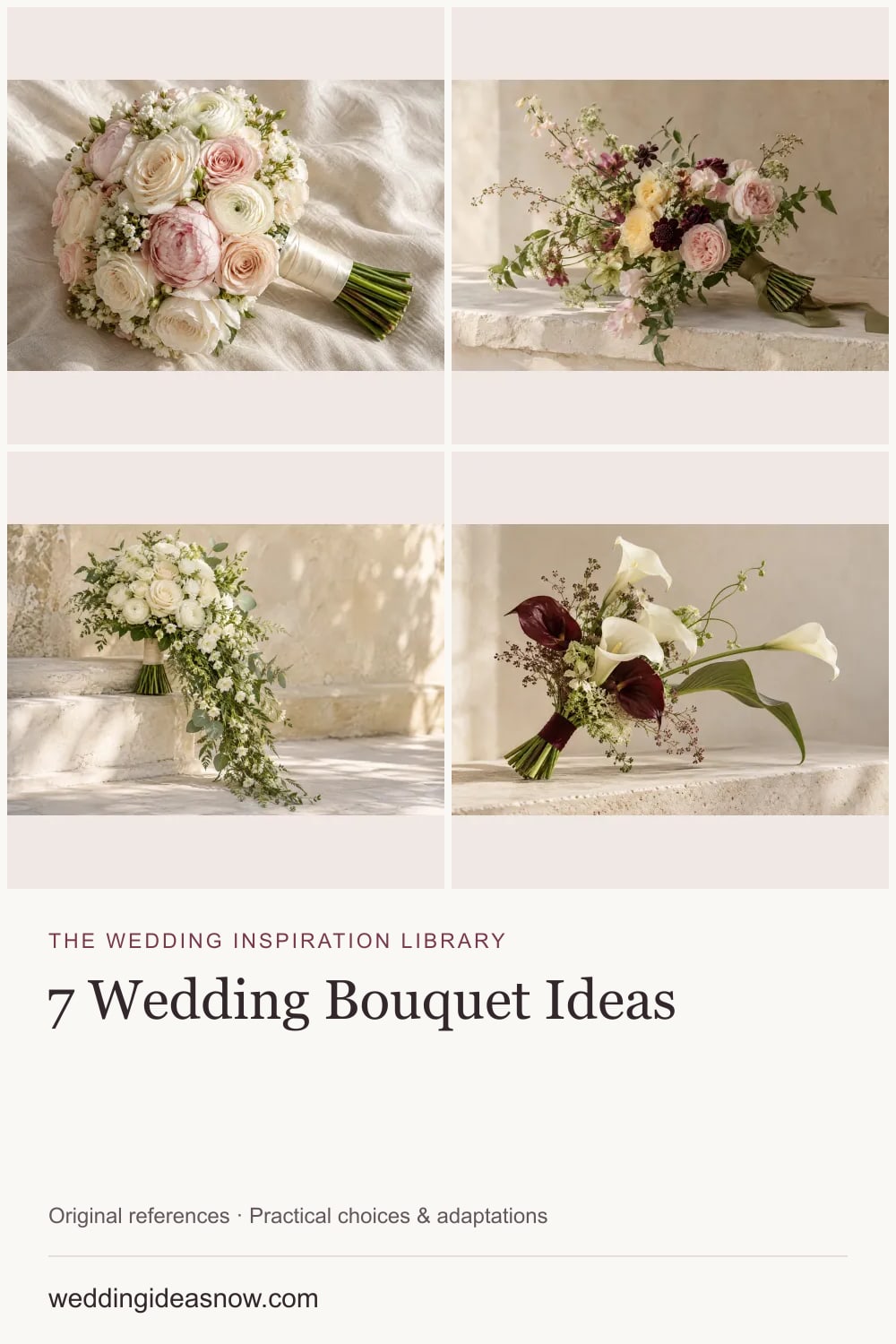
A bouquet changes the line of an outfit. A neat rounded shape creates a clear focal point; a loose gathering lets petals move; a trailing arrangement draws the eye downward. Begin with that outline, then choose color and flower character.
Compact and rounded

Flowers & bouquets
A compact rounded bouquet
Compact rounded bouquet: a defined outline and close surface.
A close grouping of flowers feels polished and deliberate. Imagine a soft ivory dome with little foliage, or a saturated pink sphere against a simple outfit. Similar-sized blooms make the surface smooth; mixed sizes create more texture without changing the overall shape. Choose this if you like a defined silhouette and an arrangement that reads clearly from a distance.
Keep the scale personal. A smaller compact bouquet can feel elegant rather than minimal; a larger one becomes a strong design feature. Tell the florist how much of the outfit you want visible and test the holding position with a comparable object.
Airy and gathered

Flowers & bouquets
An airy bouquet with space between stems
Airy bouquet: height changes and space between stems.
Open spaces, uneven heights and visible stems give this bouquet movement. Small flowers can sit above larger focal blooms, with foliage extending softly at the edges. It suits a garden mood, but an airy arrangement in one color can also feel modern. The beauty is in the gaps as much as the petals.
Ask for an intentional outline rather than “messy.” Specify whether you prefer a narrow upright gathering or a wider fan. A long ribbon adds another moving line; a short wrapped handle keeps attention on the flowers.
Trailing or cascading

A trailing bouquet brings drama below the hands, from a gentle spill to a long cascade. It can echo a train, soften a tailored outfit or contrast with a short dress. Loose trailing foliage feels different from a dense floral waterfall. Choose the line you love before asking for a specific plant.
Show the florist your preferred carrying position and the length of the trail relative to your body. Rehearse turning, sitting and handing it over. A visually light cascade can still have a substantial handle or structure.
Sculptural and single-variety

Flowers & bouquets
A sculptural bouquet with clean lines
Sculptural bouquet: shape and repetition lead the design.
A few strong stems can make a bouquet feel like a small piece of sculpture. Curving tulip-like lines, a tight group of rounded blooms or bold leaf shapes each create a different rhythm. Repeating one flower variety draws attention to its shape; mixing a few sculptural forms can feel more experimental.
This route works when you enjoy asymmetry or graphic simplicity. Describe the relationship between stems—upright, arcing, clustered or spaced—so a substitution preserves the idea if a preferred flower is unavailable.
Petite posies and alternatives to a bouquet

Flowers & bouquets
A small posy with an easy-to-read outline
Petite posy: a small, concentrated flower moment.

Flowers & bouquets
A foliage-only carrying piece
Leaf-led bouquet concept: varied green shapes replace flower heads.
A small posy offers an intimate, easy-to-read flower moment. It can be rounded or loose, colorful or quiet, and need not be reserved for a particular role. A single statement stem or a foliage-only gathering offers another simple route. The pictured leaf-led bouquet uses different green shapes for volume and line. A small botanical hoop or an arrangement of paper or textile flowers creates a different, visibly crafted object. A corsage, floral hair detail or no carried flowers at all leaves the hands free.
For paper or textile work, decide whether you want an intentionally crafted appearance or a lifelike one. Paper flowers can repeat a stationery color exactly; fabric petals can echo an outfit. Ask about edges, fastening, weight and how the piece will rest when put down.
Separate shape from flower choice
| Decision | Useful wording |
|---|---|
| Outline | “Airy and narrow, with a few stems reaching above the center.” |
| Color | “Mostly cream, with small butter-yellow centers and soft green.” |
| Texture | “Delicate petals and a little branchlike movement, not a solid dome.” |
| Scale | “Enough presence in photographs without covering the waist detail.” |
| Flexible detail | “The open shape matters more than one named flower.” |
Carry the idea through the wedding
A sculptural bouquet can connect to a single bold centerpiece; an airy one to small flowers scattered through low vases. They need not be identical. Let the bouquet be the concentrated version of the palette and the tables its quieter echo. Save the outline you prefer, then use the flower-design guide for personal flowers, ceremony and reception choices. The practical flower guide covers delivery, handling and reuse.
Preview collection Pin