In this guide
Wedding bands do not have to match each other, sit beside an engagement ring or follow one fixed style. Start by deciding how each person imagines wearing the ring: alone, stacked, only for certain occasions or as part of a different personal symbol. Then compare width, profile and finish on the actual hand.

Rings & accessories
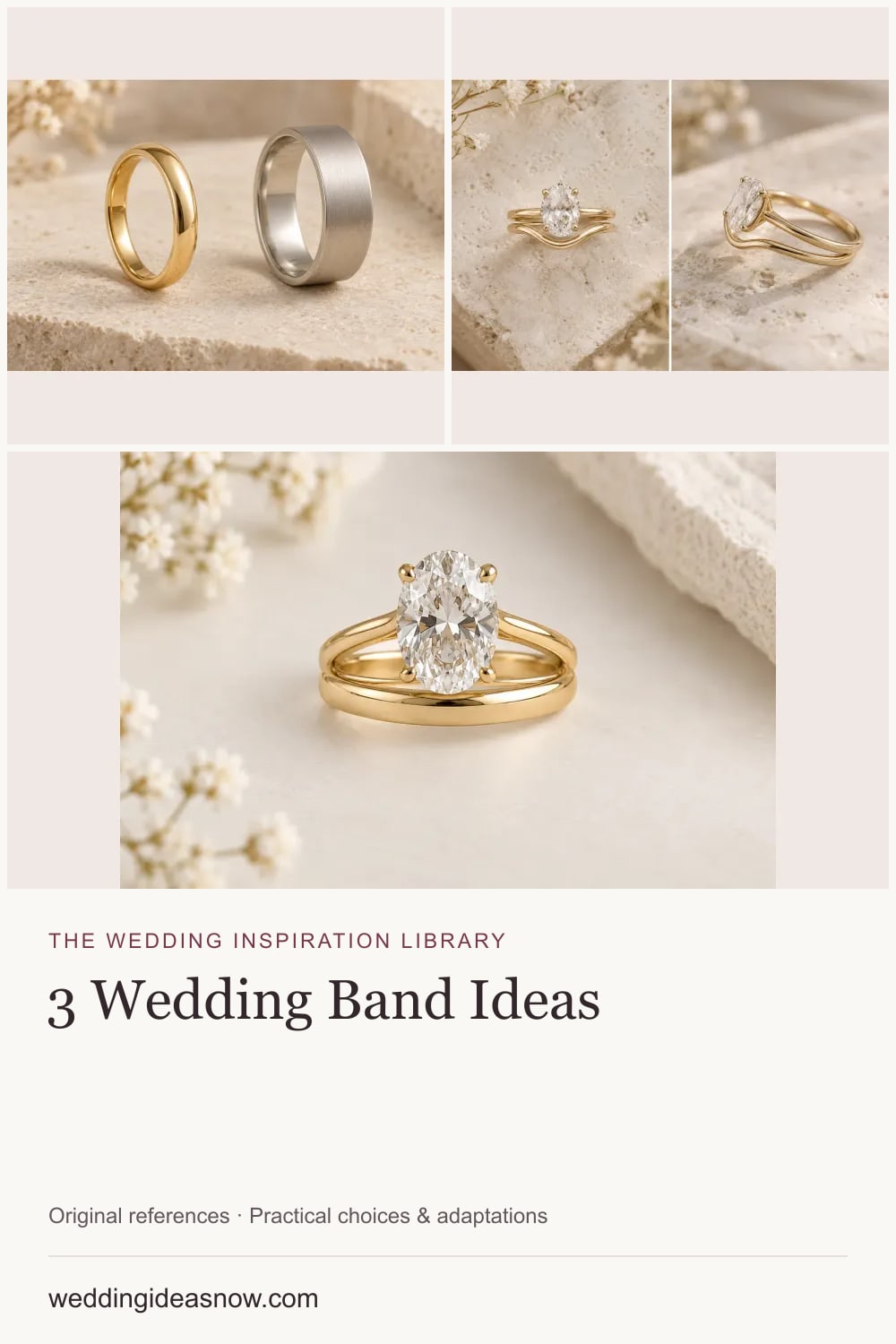
Plain bands with different width and finish
Width, edge shape and finish make plain bands visually different even without stones.

Rings & accessories
A curved band around a solitaire
A curved band follows the center setting instead of forming a straight line underneath it.

Rings & accessories
A straight band with visible space beside a setting
A close view of an oval solitaire and a straight band shows two independent outlines around the setting.
Find the design relationship you like
| Direction | Why choose it | What to compare in person |
|---|---|---|
| Plain rounded band | A continuous soft-looking line with little visual interruption | Width, inner profile, edge feel and how it moves with the fingers |
| Flat or squared profile | A more geometric outline that can feel deliberately architectural | Edges, thickness and comfort next to neighboring fingers |
| Brushed, hammered or engraved surface | Texture becomes the detail rather than an added stone | How the finish changes with wear, whether it can be renewed and what service costs |
| Stone-set band | A repeated pattern or line of detail across part or all of the ring | Setting height, maintenance, sizing limits and contact with neighboring rings |
| Curved, contoured or open shape | A deliberate space around another ring or a shape that stands alone | The exact fit beside the intended ring, how it rotates and whether it feels complete alone |
| Contrasting bands for the couple | A shared occasion expressed through different tastes | A common engraving, finish or private meaning if you want a connection without identical designs |
Pair rings from the side as well as the top
Try the engagement ring and prospective band together. Look for the space between them, where their surfaces touch and how they sit when you close your hand. A straight band may leave a gap; a contour may follow the setting more closely. Either can be an intentional look. Do not assume “flush” is always the correct result.
Ask the jeweler whether the particular pieces can rub or damage one another, which pairing they recommend and why. If you plan to wear a band alone while working or traveling, inspect it by itself too. A dramatic contour designed around one setting may have a very different appearance without that ring beside it.
A simple comparison exercise: try one narrow plain band, one wider plain band and one shaped or textured alternative. Take the same top and side photographs with permission. Note your immediate comfort, the relationship to your existing ring and what you would need to confirm before ordering. Do not use width alone to guess the final fit.
Ask what the material actually is
The US FTC's jewelry guidance explains that gold fineness, platinum descriptions, sterling silver and plated finishes have different meanings. Karat for gold is different from carat weight for a gemstone. Request the actual composition, finish and any plating in writing; appearance alone is not a specification.
For any metal or alternative material, ask about the exact alloy, care, repairs and resizing options for that ring. If a wearer has a known material sensitivity, discuss the actual composition with the jeweler and an appropriate clinician where needed. We do not label a material universally allergy-free, scratch-proof or suitable for every job.
Decide what personalization is worth to you
An interior date, short phrase, symbol or private joke can make a plain band feel specific. First check character limits, type size, spelling, engraving method and whether personalization changes returns or later resizing. Confirm the final wording in writing. You can also leave the bands unengraved and add a personal detail later.
If using an heirloom, discuss condition and options before altering it. Keeping a piece intact, wearing it on another occasion or borrowing its design language may feel more appropriate than changing it. Obtain the owner's consent where the item is shared family property. Do not treat a sentimental object as an ordinary replaceable blank.
A complete original selection brief
“We prefer different widths, but both like a softly rounded profile. One band will be worn beside an existing engagement ring and the other alone. We want to compare a polished and a brushed finish, understand the actual material and resizing options, and confirm care and delivery before choosing an engraving. Our combined limit, including personalization, is __.”
Record each person's choice separately: size as measured by the provider, width, profile, finish, material description, stone details if any, engraving, total quote and collection date. A shared spreadsheet cell saying “rings done” will not preserve those differences.
Bring the rings into the ceremony plan
Assign who checks the rings, who carries them and who receives them at the ceremony. Use a secure container chosen for the actual setting. If a child or pet is involved, an adult can carry the real rings while the symbolic role remains theirs. Tell the officiant how the exchange will work, including a no-ring or alternative-symbol option.
After fitting and purchase, keep the supplier's written care advice and documents. Whether you arrange insurance or specialist storage is a separate decision to review with the relevant provider; a ring design guide cannot establish coverage or replacement value.
Preview collection Pin
Sources & further checks
- US Federal Trade Commission — buying platinum, gold and silver jewelry
- US Federal Trade Commission — buying gemstones, diamonds and pearls

