In this guide
A ring can be a shared design decision, a carefully discussed surprise or something you choose after the proposal. Start with the wearer's preferences: whether they want a ring at all, what they enjoy wearing every day and how much choice they want in the purchase. A temporary or symbolic ring can leave space for that conversation.

Rings & accessories
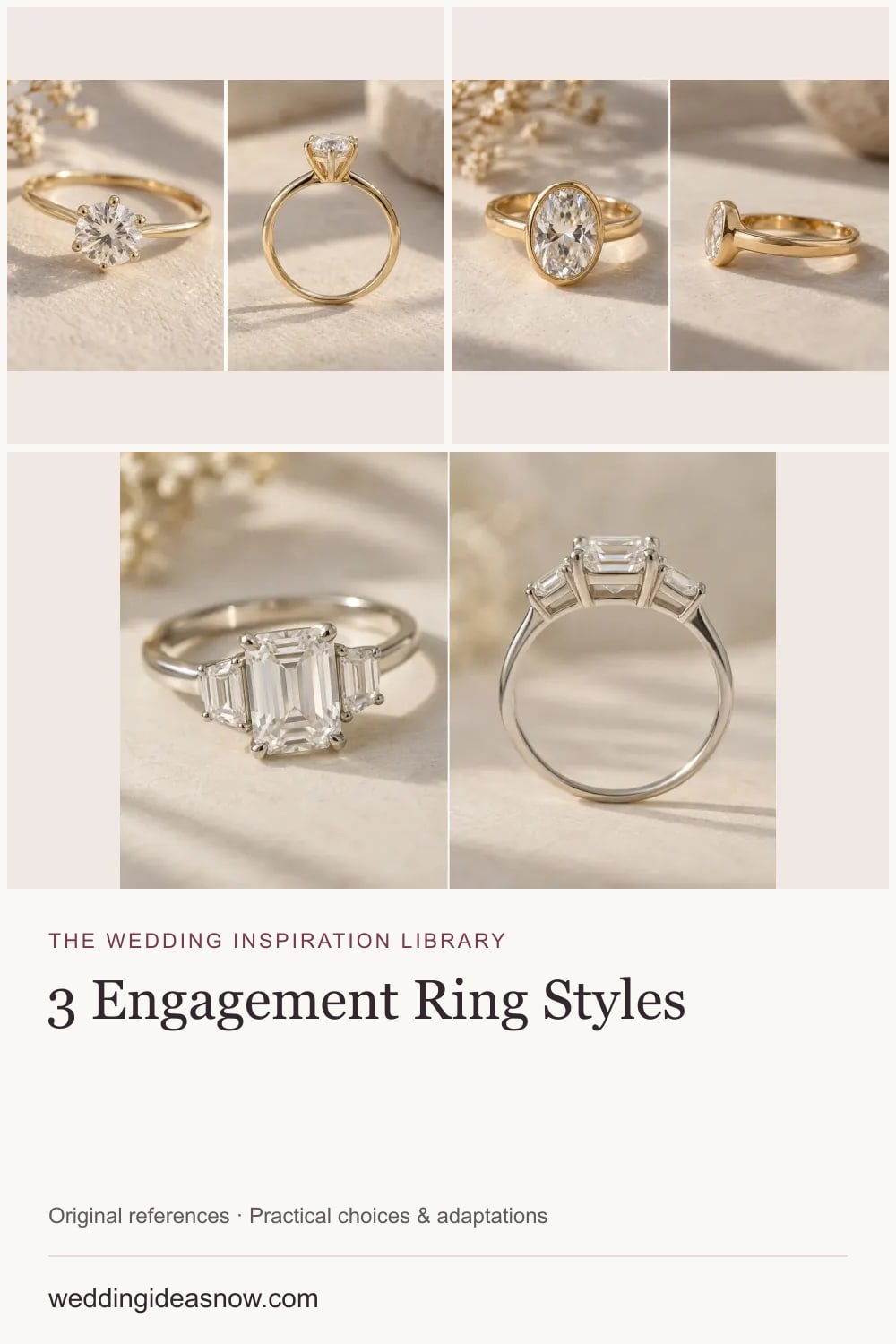
Round solitaire with an open setting
A round center and open setting emphasize the single stone, with its raised profile visible beside the top view.

Rings & accessories
An oval outline inside a smooth bezel
An oval center and a continuous metal border create an elongated, contained shape.

Rings & accessories
A rectangular center with side stones
A long rectangular center and smaller side stones create a broader composition across the finger.
Separate the shape from the setting
Start with the outline alone
Cover the setting for a moment and compare the outside line. These original drawings isolate shape so you can describe a preference without confusing it with a grading term.
Round
A continuous circular outline.
Oval
A curved shape that is longer in one direction.
Rectangular
Straight sides and clipped corners; compare the length-to-width relationship.
Square
Four equal-looking sides with distinct corners.
Softened square
A squarer outline with rounded edges and corners.
Pear
One pointed end and one rounded end; try which way you like to wear it.
Pointed oval
An elongated curve with a point at each end, often called a marquise outline.
These are shape sketches, not facet diagrams, actual stones or equal-carat comparisons. A similar outline can be cut in different ways. Ask the jeweler for the actual dimensions, cutting style and relevant report; shape alone does not establish cut quality, material, value or sparkle.
The stone's outline is one choice; the structure holding it is another. A round outline with a fine open setting, an oval enclosed by a metal rim and a rectangular center with side stones tell different visual stories. Compare top and side views, because a ring that looks compact from above can sit high on the finger.
| Direction | What to notice | Question to ask |
|---|---|---|
| Round center in prongs | A circular outline with visible support points and open areas around the stone | What holds the stone in this particular setting, and how should those points be inspected? |
| Oval or elongated outline | A longer shape and a different relationship to the band | How does it sit across this finger, and will a wedding band fit beside it? |
| Rectangular / step-cut look | Straighter edges and broad geometric planes | What proportions and visual features should we inspect in the actual stone? |
| Pear, marquise or asymmetric shape | A directional or pointed outline | How does the setting protect and support the shape, and which orientation feels right? |
| Bezel or rimmed setting | Metal visibly follows the stone's perimeter | How high is the complete ring, and what cleaning, repair and resizing does this design permit? |
| Three-stone or clustered arrangement | A composition across the finger rather than one isolated center | How do the stones, setting and future band sit together from every angle? |
| Plain band or non-stone design | The material, width, texture or personal meaning becomes the focus | What finish and profile feel good in daily wear, and how can the design be maintained? |
Our pictured rings are original design concepts. They show relationships to discuss, not a manufacturer's product or proof that a specific construction is suitable. Ask a qualified jeweler to assess the actual design, fit and care needs.
Know what the grading language does—and does not—describe
For diamonds, GIA's four quality factors are color, clarity, cut and carat weight. Shape is not the same as a cut-quality grade, and carat is weight rather than a measurement of the visible face. Use grading information alongside inspection of the actual stone and the limits of your own budget; one isolated number cannot choose the ring for you.
Ask what report is supplied, which laboratory issued it, how the seller matches it to the stone and how you can verify the report through that laboratory. A grading document does not settle the seller's return terms, your personal taste or every question about the finished ring.
Ask for clear origin and treatment information
The US FTC's gemstone guidance distinguishes mined stones, laboratory-created stones and imitations, and explains why treatment and care information matter. Ask the seller to describe the actual stone in writing, including origin category, disclosed treatments and special care. Do not treat words such as “created,” “simulated” or “natural” as interchangeable.
You may choose a colored gemstone, diamond, inherited stone, no center stone or no ring. If environmental or labor standards are important to your choice, ask for the specific evidence behind the seller's claim and what stages it covers. A broad label does not by itself establish the history of one item. We do not promise resale value or universal ethical superiority for a material or origin.
Compare the whole ring and the whole purchase
Request the actual metal composition and any plating, finished width and height, stone details, total price, alteration options and care instructions. In US consumer guidance, the FTC explains metal and quality marks; local labeling rules can differ. Ask what the mark means for this item rather than assuming its color tells you its composition.
- Fit: how will the jeweler measure the wearer, and what changes are possible later?
- Daily use: discuss work, hobbies and situations in which the jeweler recommends removing the ring.
- Band pairing: try a straight and a shaped band beside it before assuming they will sit flush.
- Purchase terms: confirm deposit, completion date, return/exchange rules and the effect of personalization or resizing.
- Ongoing care: ask about checks, cleaning, repairs, warranty exclusions and charges.
- Documentation: keep the item description, receipt, report where relevant and any written promises together.
Two original buying briefs
“We want to compare a round center in an open setting with an oval in a rimmed setting. The wearer prefers a lower profile and wants to try a wedding band alongside it. Our complete spending ceiling is __. Please describe stone origin/treatments, metal, fit, maintenance and return/resizing terms separately from the design options.”
“We would like to explore resetting a family stone, but keeping the existing piece intact is also an option. Please assess its condition before proposing work, explain any risks and approvals, and give us a written scope. We do not want irreversible work to begin until we approve the design.”
If the proposal is a surprise
Keep the proposal moment separate from an irreversible design decision. A private conversation about preferences can preserve surprise in timing and setting. If you do not know the wearer's size, material preferences or appetite for public attention, a placeholder ring or no-ring proposal may be the more considered choice. The proposal guide helps plan the experience; the shortlist can hold jeweler questions and appointments.
Preview collection Pin
Sources & further checks
- GIA — diamond quality factors and the 4Cs
- US Federal Trade Commission — buying gemstones, diamonds and pearls
- US Federal Trade Commission — buying platinum, gold and silver jewelry
- GIA — four-prong and six-prong setting comparison
- GIA — how to buy a diamond
